Headless vs Composable Commerce: What's the Difference and Which Do You Need?
Updated: 1 day ago

Headless vs composable commerce is a comparison between two ecommerce architectures: one that separates the storefront from the backend, and one that also splits the backend into independently chosen services.
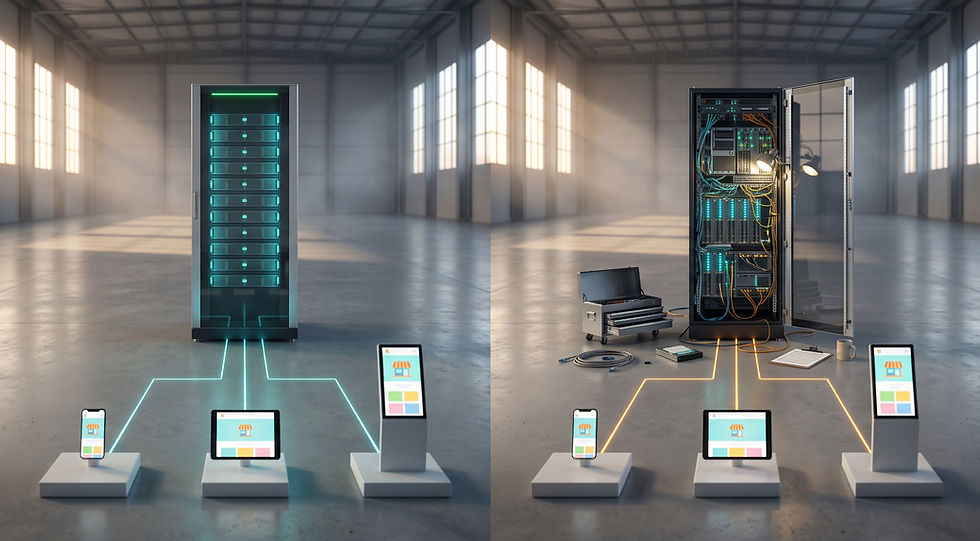
Headless commerce decouples the frontend from commerce logic and connects the two through APIs. Composable commerce goes a step further and treats the backend itself as a set of swappable parts, each one picked from a different vendor.
Every composable build is headless, but most headless builds are not composable. The real decision is how many vendors you want to own the integration between, and the answer depends on team size more than on ambition.
Quick Answer: Headless commerce separates your storefront from a single commerce backend, while composable commerce assembles that backend from multiple independent services. Choose headless with an integrated backend when a small team needs to ship and maintain a store. Choose composable when you have the engineering capacity to own every integration between vendors.
What is headless commerce?
Headless commerce is an architecture where the customer-facing frontend is built and deployed separately from the backend that handles products, carts, checkout and orders. The frontend calls the backend through APIs, so you can build it in any framework and render it on any channel.
The backend in a headless setup is usually one platform. Catalog, inventory, checkout, payments and order management live together, share a data model and are maintained by the same vendor.
Wix Headless is an example of that model: it gives a custom frontend a managed backend with eCommerce, payments, bookings, events and a CMS behind one connection. You write the storefront in React, Vue, Svelte or Solid, and the business logic arrives already integrated.
The tradeoff is scope. A single headless backend decides how its cart, tax and promotion logic behave, so you accept its model for those domains in exchange for not having to wire them together yourself. That's the same separation covered in our guide to what a headless commerce platform does.
What is composable commerce?
Composable commerce is an approach where the commerce backend is assembled from independent, best-of-breed services rather than bought as one platform. Each business capability is a separate product with its own API, contract and release cycle.
A typical composable stack picks a different vendor for each domain. The usual split looks like this:
A commerce engine for catalog, cart and pricing
A separate headless CMS for editorial content
A dedicated search and merchandising service
A payments provider and a tax calculation service
An order management system for fulfillment and returns
Composable commerce is usually described through the MACH Alliance's principles. The alliance defines MACH as microservices, API-first, cloud-native SaaS and headless, and frames the goal as letting you "select best fit solutions for each domain, instead of one large platform."
The nuance: composable commerce does not remove integration work, it relocates it. The glue code between your search service, your CMS and your commerce engine becomes a product your team owns, versions and pages someone for at 2 a.m.
Headless vs composable commerce: how the two architectures differ
Headless and composable commerce differ in where the seams are. Headless commerce has one seam, between frontend and backend. Composable commerce has that seam plus one between every pair of backend services that need to share data.
That difference shows up in four places: who integrates, who you call when something breaks, how fast you can launch and what you can swap later.
Dimension | Headless commerce | Composable commerce |
Frontend | Decoupled, any framework | Decoupled, any framework |
Backend | One integrated platform | Multiple independent services |
Integration owner | Platform vendor | Your team or an agency |
Vendors to manage | Usually one | Often five or more |
Time to first launch | Weeks | Months |
Swapping one capability | Limited to platform options | Replace one service at a time |
Best fit | Small teams, agencies, AI builders | Large teams with dedicated platform engineers |
The table hides one important detail. A headless backend can still be extended with outside services through its APIs and webhooks, so the line between the two models is a spectrum rather than a wall. Most production stacks sit somewhere in the middle, as our breakdown of how headless commerce architecture scales shows.
Why composable commerce costs more than the license fees suggest
Composable commerce costs more than its line-item pricing because the most expensive component is the one no vendor sells you: the integration layer. Every service boundary needs data mapping, error handling, retries and monitoring.
Checkout is where those seams hurt most. A single order can touch inventory, pricing, promotions, tax, payments and fulfillment, and in a composable stack each of those may be a different API with a different failure mode. Our walkthrough of how a headless checkout is built shows how much logic hides in that one flow.
The ongoing cost is maintenance. Vendors deprecate endpoints, change rate limits and ship breaking versions on their own schedules, and your team absorbs each of those changes.
"The thing that costs agencies the most isn't building the site, it's everything that comes after. Maintaining plugins, managing integrations, being the permanent help desk because the client can't figure out the backend. Wix Headless eliminates that entirely. You hand over a clean dashboard, the client runs it themselves and you move on to the next project."
— Moran Shemesh, Engineering, Wix
Here's the subtlety: the client-facing cost of composable commerce is often the admin experience, not the code. When content lives in one tool, orders in another and promotions in a third, the merchant has to learn three dashboards, and that support burden lands back on whoever built the stack.
When headless commerce is the right choice
Headless commerce with an integrated backend is the right choice when the constraint is engineering capacity rather than capability. It fits teams that want a custom frontend but don't want to operate a distributed backend.
These signals point toward headless with one backend:
The team has fewer than three engineers who can own backend integrations
The store needs to launch in weeks, not quarters
Merchants or clients need to run the store from one dashboard
The product catalog and checkout rules are standard rather than exotic
The frontend is being generated or iterated quickly with AI coding tools
An integrated backend also makes the API surface simpler to reason about. You call one set of endpoints with one authentication model, which matters when you're choosing between REST, GraphQL and other API architecture patterns for the frontend.
When composable commerce is the right choice
Composable commerce is the right choice when one specific capability is a competitive differentiator and no integrated platform does it well enough. That might be search relevance, complex B2B pricing or a multi-region order management workflow.
Composable architecture also suits organizations that are already large. A team with dedicated platform engineers, an integration budget and a long time horizon can justify owning the seams in exchange for replacing one part at a time.
The nuance: the strongest argument for composable is replaceability, but it only pays off if you actually replace things. Teams that assemble a composable stack and then never swap a component paid the integration cost without collecting the benefit.
How to choose between headless and composable commerce
Choosing between headless and composable commerce comes down to a short, honest audit of your team and your differentiators. Work through these checks in order:
List the capabilities your store needs, from catalog to returns.
Mark the ones that are true differentiators for your business, not just requirements.
Count the engineers who could own an integration in production, including on-call.
Estimate the cost of maintaining each integration for three years, not just building it.
Start with an integrated headless backend and add an outside service only where a differentiator demands it.
That last step is the practical middle path. You get a decoupled frontend and one managed backend on day one, then compose selectively where the business case is real.
Headless vs composable commerce FAQs
Is composable commerce the same as headless commerce?
No. Headless commerce separates the frontend from the backend. Composable commerce also breaks the backend into independent services from different vendors. All composable commerce is headless, but headless commerce can run on a single integrated backend.
What is MACH architecture in composable commerce?
MACH architecture is a set of design principles for composable systems: microservices, API-first, cloud-native SaaS and headless. The MACH Alliance promotes these principles as a way to build a stack where each component can be added, replaced or removed independently.
What is a packaged business capability in composable commerce?
A packaged business capability is a self-contained software component that handles one business function, such as cart, search or pricing, and exposes it through an API. Composable commerce stacks are assembled from these capabilities.
Is headless commerce cheaper than composable commerce?
Headless commerce on an integrated backend is usually cheaper to build and maintain, because one vendor owns the integration between commerce capabilities. Composable commerce adds the cost of building, monitoring and updating the connections between every service.
Can you move from headless commerce to composable commerce later?
Yes. A headless frontend already talks to the backend through APIs, so you can route one capability, such as search, to a specialist service without rebuilding the storefront. That incremental path is lower risk than starting fully composable.
Headless commerce is the practical starting point for most teams
Headless commerce with an integrated backend gives most teams the frontend freedom they want without the integration burden composable commerce adds. Composable commerce earns its cost only when a specific capability is a real differentiator and a team exists to own the seams.
Start decoupled, keep the backend unified and compose only where the business case is proven. Set up a Wix Headless commerce backend and connect your frontend to it.


Comments