Headless Commerce Architecture: How It's Built & Why It Scales
Updated: 2 days ago

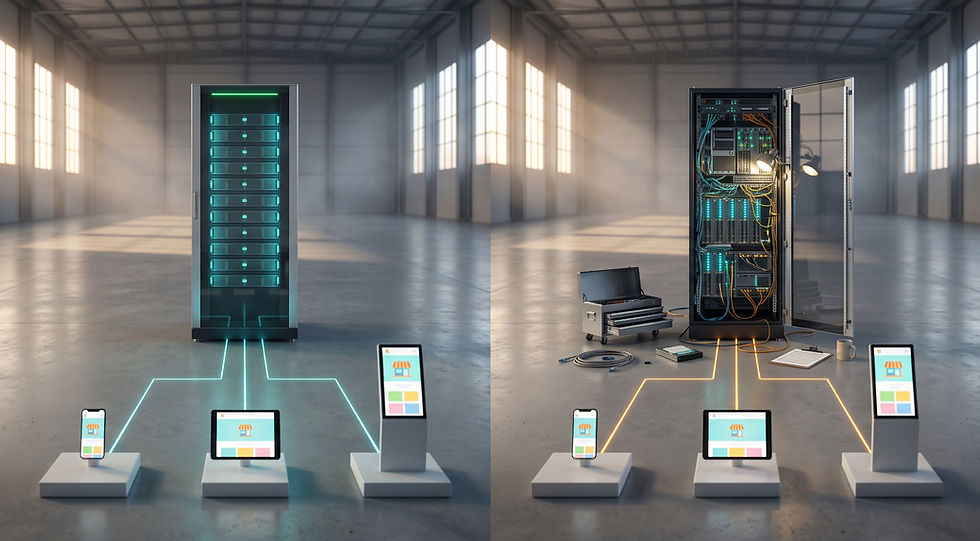
Headless commerce architecture decouples the frontend presentation layer from the backend commerce engine, connecting the two through APIs. Instead of a monolithic platform where the storefront, product catalog, checkout, and CMS are bundled together, you get a stack of discrete services, each ownable, swappable, and scalable on its own terms.
That separation is what makes headless commerce the default choice for brands running high-traffic storefronts, multi-channel retail, or any commerce operation where a shared deploy cycle between backend changes and storefront updates is a growth bottleneck. Understanding how the layers fit together, and where the complexity actually lives, is the key architectural decision before you commit to a Wix Headless architecture approach.
Quick Answer: Headless commerce architecture splits your storefront (frontend) from your commerce engine (backend APIs for catalog, cart, checkout, inventory, and orders). The two layers communicate over APIs. This gives development teams the freedom to build any frontend experience while the commerce backend handles transactional logic, and lets you update either layer without coordinating a joint deploy.
What Headless Commerce Architecture Actually Means
The concept has a specific origin: Dirk Hoerig, co-founder of commercetools, coined the term "headless commerce." As he explained, the architecture "allows the separation of commerce functionality and performance from the user experience", the storefront is no longer the head of a monolithic system, it's a detachable frontend consuming structured data from a backend that doesn't know or care what framework renders it. (Source: Forbes, October 2022.)
In practice, this means three distinct layers:
The frontend, any rendering layer: a Next.js app, a React Native mobile client, a Vue storefront, a kiosk, or an AI agent composing a checkout flow programmatically.
The API layer, the contract between frontend and backend. REST or GraphQL endpoints expose product data, pricing, cart operations, checkout, and order management.
The commerce backend, the services that own transactional state: product catalog, inventory, pricing rules, promotions, checkout and payment processing, order management, and customer accounts.
None of these layers needs to know the implementation details of the others. Your frontend team can migrate from Gatsby to Next.js without touching the commerce backend. Your backend team can swap payment processors without a frontend redeploy.
The nuance: "headless" doesn't mean stateless on the backend. The backend is still responsible for transactional integrity, inventory reservations, payment idempotency, order state machines, and tax calculations are genuinely hard problems. Headless architecture gives you freedom at the frontend in exchange for taking full ownership of those backend concerns, whether you build them yourself or use a managed platform that provides them.
The MACH Principles and How They Apply to Commerce
Most modern headless commerce architectures are described through the MACH framework (coined by the MACH Alliance, founded June 2020):
Microservices, each commerce capability (catalog, checkout, promotions, search) is a separately deployable service with its own data store and release cycle.
API-first, every capability is exposed as an API before any frontend consumes it. No internal shortcuts.
Cloud-native, services run on managed infrastructure with autoscaling, health checks, and distributed persistence.
Headless, the frontend is decoupled from every backend service; it only communicates via the published API contract.
MACH isn't a requirement to run headless commerce, you can build a simple decoupled storefront without microservices. But MACH is the right frame for understanding what you're working toward when headless commerce scales beyond a single frontend team: independent release cycles, horizontal scaling per service, and the ability to replace one component without a system-wide coordinated change.
According to the MACH Alliance, 94% of enterprises report MACH-based composable architecture accelerates AI deployment speed, a useful benchmark for teams deciding whether the complexity is worth it.
The Four Architectural Layers in Detail
1. Frontend (The Experience Layer)
The frontend is responsible for rendering and UX. In a headless commerce setup, it's typically built with a JavaScript framework, Next.js is dominant in 2026 for its support of both static generation and server-side rendering in one codebase, but the architecture is framework-agnostic.
What the frontend owns: page rendering and routing, client-side state (cart UI, session handling), design system and component library, performance optimization (ISR, CDN caching strategy, Core Web Vitals).
What the frontend delegates to the API: product data, pricing, and availability; cart creation, item management, and checkout; customer authentication and account state; order history.
Here's the subtlety: frontend performance in headless commerce is a real engineering concern, not a free benefit. Pre-rendering product catalog pages at build time can make them fast, but a 200,000-SKU catalog with daily price changes breaks the "build everything at deploy time" model. Real production headless storefronts use ISR (revalidate product pages every N minutes), on-demand revalidation via webhook (trigger a rebuild when product price changes), and SSR for highly personalized pages. Getting this caching strategy wrong is one of the most common headless commerce performance regressions.
2. The API Layer
The API layer is the contract between frontend and backend, serving two functions: data retrieval (product catalog, search, recommendations) and transactional operations (add-to-cart, checkout, order management).
Most modern headless commerce backends expose REST APIs for standard CRUD operations, GraphQL for flexible data fetching on product detail and listing pages, and webhooks for event-driven updates (inventory changes, order state transitions) that trigger frontend cache invalidation or downstream integrations.
API design quality matters disproportionately in headless commerce because the frontend has no fallback, if the catalog API is slow, the page is slow. Rate limits, pagination design, and response shape directly affect storefront build time (for SSG) and page load time (for SSR).
3. The Commerce Engine (Backend Services)
The commerce engine owns everything transactional. In a MACH architecture, this is a set of microservices; in a managed headless platform, it's a set of APIs backed by managed infrastructure you don't provision.
Service | What It Owns |
Product Catalog | SKUs, variants, attributes, media, categories, pricing |
Inventory | Stock levels, warehouse allocation, reservation logic |
Pricing & Promotions | Price lists, customer-specific pricing, discount rules |
Cart & Checkout | Cart state, shipping calculation, tax, payment orchestration |
Order Management | Order state machine, fulfillment routing, returns |
Customer / CRM | Account creation, authentication, address book, loyalty |
Search | Product indexing, faceted search, ranking logic |
4. Integration & Orchestration Layer
In mature headless commerce stacks, a fourth layer coordinates cross-service workflows: an event bus (Kafka, SQS) for async communication between services, a BFF (Backend for Frontend) pattern for aggregating multiple API calls into a single frontend-optimized response, and CDN edge logic for geo-routing and A/B testing at the network layer.
This layer is where self-managed headless commerce adds the most operational overhead compared to a managed platform, and where the build-vs-buy decision is sharpest.
Composable Commerce vs. Pure Headless
Pure headless means you've decoupled your existing commerce platform (Shopify, BigCommerce, Magento) from its default storefront and built a custom frontend on top of its APIs. The backend is still a bundled platform; you've just replaced the front end.
Composable commerce is the full MACH vision: every backend service is independently selected, deployed, and replaceable. You might use commercetools for the commerce engine, Sanity for CMS, Algolia for search, Stripe for payments, and build the orchestration layer yourself.
Pure Headless | Composable Commerce | Time to first deploy | Best fit | |
Backend vendor lock-in | High | Low | Weeks vs Months | Mid-market vs Enterprise |
Operational complexity | Medium | High | ||
Customization ceiling | Bounded by platform API | Near-unlimited |
Ready to provision a headless commerce backend without the MACH assembly overhead? Explore Wix Headless →
What a Managed Headless Backend Handles for You
One of the practical splits in headless commerce today is between teams that assemble their own commerce services (composable) and teams that use a managed headless backend providing all the commerce primitives as a single API surface.
Wix Headless takes the second approach: it exposes catalog, cart, checkout, orders, bookings, memberships, events, and CMS through the same Wix REST/SDK API. Your frontend (Next.js, Astro, a React Native app, or an AI agent) calls those APIs at build time or request time without any of the backend infrastructure to manage.
As Shahar Talmi, GM of Wix's Developer Platform, explained in the July 2026 announcement of Wix Headless for AI coding tools: "an AI agent doesn't just generate a storefront, it turns it into a fully functional and sustainable business." The commerce backend, checkout, payments, inventory, order management, is live and production-ready at the moment the frontend is wired up, not something to build after the storefront ships.
The nuance: managed headless backends trade flexibility for time-to-launch. You get a production-ready commerce API on day one, but the service boundaries and data models are set by the platform. Teams with highly custom pricing logic, unusual fulfillment workflows, or non-standard product models may hit limits faster than a self-assembled MACH stack. Evaluate the platform's extension points (webhooks, custom fields, code-level extensions) against your specific commerce requirements before committing.
When Headless Commerce Architecture Is (and Isn't) the Right Choice
Use headless commerce when you're running multiple storefronts that share one commerce backend, your frontend team has strong JavaScript/React expertise, you're in a high-GMV environment where frontend performance is a revenue lever, or you need to integrate custom logic (ERP, PIM, loyalty platform) a bundled platform can't surface cleanly via API.
Reconsider headless commerce when your team is small (under 3 developers), your product catalog is simple and static, your primary need is an editor-friendly CMS workflow rather than custom storefront performance, or you're pre-product-market fit, the operational overhead of a decoupled stack is a drag on iteration speed.
FAQ
What is headless commerce architecture?
Headless commerce architecture separates the storefront (frontend) from the commerce engine (backend). The two layers communicate via APIs. This lets teams build and update the frontend independently from backend commerce logic, product catalog, cart, checkout, and order management.
What's the difference between headless commerce and traditional ecommerce?
In traditional ecommerce (Shopify with default themes, WooCommerce, Magento), frontend and backend are bundled, a backend change can require a frontend redeploy, and design is constrained by the platform's templating system. Headless commerce decouples them: the backend exposes APIs, and any frontend can consume them.
What is MACH architecture in ecommerce?
MACH stands for Microservices, API-first, Cloud-native, Headless. It's an architectural framework for composable commerce where each backend service is independently deployable and replaceable. The MACH Alliance, founded in June 2020, promotes this model as the standard for modern enterprise commerce.
What's the difference between headless commerce and composable commerce?
Pure headless replaces the storefront of an existing platform with a custom frontend. Composable commerce goes further, every backend service is independently chosen and assembled. Composable commerce is a superset of headless: all composable architectures are headless, but not all headless architectures are composable.
What are the disadvantages of headless commerce?
Higher upfront development cost, more complex infrastructure, and longer time-to-first-deploy compared to a bundled platform. Frontend caching strategy (ISR, on-demand revalidation) requires careful design to avoid performance regressions. Teams also own more of the end-to-end QA cycle across service boundaries.
Which frontend framework is best for headless commerce?
Next.js is the dominant choice in 2026 for its support of SSG, SSR, and ISR in a single framework. Astro is a strong alternative for content-heavy storefronts where zero-client-side JavaScript by default is a Lighthouse performance priority. SvelteKit is a good fit for teams that prefer Svelte over React.
Headless commerce architecture is the right default for any commerce operation that's outgrown the constraints of a bundled platform's frontend, or that runs multiple client surfaces that need to share a single transactional backend.
The core architectural decision isn't "headless vs. traditional", it's where you draw the line between assembling your own services (full composable, maximum flexibility, maximum overhead) and using a managed backend (faster launch, managed infrastructure, bounded customization). Most teams land somewhere in the middle: a custom Next.js frontend connected to a managed commerce backend that provides catalog, checkout, and order management out of the box.
The commerce primitives you need, catalog, cart, checkout, orders, memberships, should be production-ready when your frontend ships, not six months later. Wix Headless provides those through a single API surface your team calls at build or request time.


Comments