Wix-Managed Headless vs Self-Managed Headless: Which Should You Run?
Updated: 10 hours ago
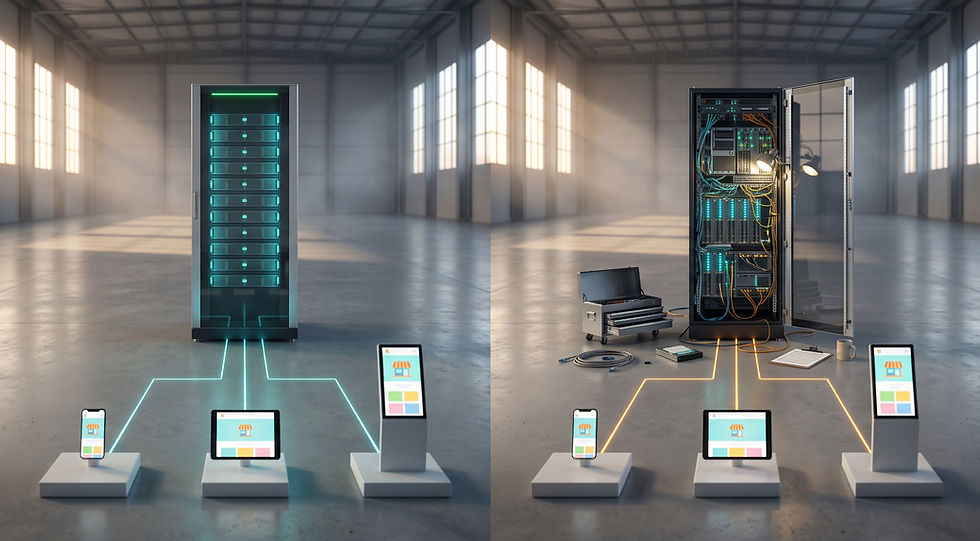
Wix-managed headless is a headless setup where Wix hosts and operates the backend while you build and own the frontend. Self-managed headless is the opposite arrangement: your team chooses, deploys and runs every backend service itself.
Both models give you a decoupled frontend talking to a backend over APIs. The real difference is who carries the pager when the checkout fails on a holiday weekend.
For most teams shipping commerce, bookings or client sites, the managed model wins on time to launch and total cost of ownership. Self-managed earns its keep when you have a hard requirement that a managed platform can't meet.
Quick Answer: Choose Wix-managed headless if you want a production backend for content, commerce, payments and bookings without running servers, patching dependencies or planning capacity. Choose self-managed headless if you have a dedicated platform team and a hard requirement, such as hosting in your own environment or modifying backend source code.
What is the difference between Wix-managed and self-managed headless?
Headless architecture is a design where the frontend presentation layer is separated from the backend that stores content and runs business logic, with the two connected through APIs. Every headless project makes that split. The open question is who operates the backend half.
In a self-managed headless stack, your team assembles the backend from parts. A typical build pairs a self-hosted open-source headless CMS such as Strapi with a commerce engine such as Medusa, a payment processor, a database and a hosting provider. Each piece is yours to deploy, monitor, patch and scale.
In a Wix-managed setup, the backend arrives already assembled, which is the same model as headless CMS as a service extended past content into commerce and operations. Wix Headless provides stores, bookings, events, a headless CMS, a blog and payments as ready-made business solutions, so your frontend connects to a backend that is already running on infrastructure Wix operates.
The operational split between the two models comes down to four areas:
Hosting and scaling: self-managed teams provision servers and plan for traffic spikes, while a managed backend auto-scales on infrastructure the provider runs.
Security patching: self-managed teams track vulnerabilities across every dependency, while a managed provider patches the platform.
Payments compliance: self-managed teams own their share of PCI DSS scope, while a managed checkout keeps card handling on the provider's side.
Upgrades: self-managed teams schedule and test major-version migrations, while a managed platform ships changes behind a stable API.
The nuance: "managed" and "self-managed" can apply separately to the frontend and the backend. With Wix, a project can run fully Wix-managed on an Astro-based frontend that supports React, Vue, Svelte and Solid, or you can host your own frontend on Vercel, Netlify or AWS and call the Wix backend through its APIs and JavaScript SDK.
What does a self-managed headless stack require you to run?
Self-managed headless gives you complete control over every layer, and that control comes with operating responsibility. Before choosing it, list every service your team will own in production:
Infrastructure: compute, a database, file storage, a CDN, and separate staging and production environments.
Business services: the CMS, catalog, inventory, cart, checkout and order management, plus any bookings or events logic.
Integrations: payment gateways, tax, shipping, email and analytics, each with its own credentials, webhooks and failure modes.
Operations: monitoring, alerting, backups, incident response and on-call coverage.
Security and compliance: dependency patching, access control, secrets management and audit evidence for PCI DSS and privacy rules.
None of these items is exotic. The cost comes from owning all of them at once, indefinitely, on every project you ship.
For agencies, the burden keeps growing after launch, because every client site adds another backend to maintain. Wix's UX lead put the cost in plain terms:
"Every time you rebuild the backend from scratch for a new client, you're leaving money on the table. Wix Headless means the infrastructure is already there: you spin up the frontend for each client and connect it in one prompt. More launches, same team."
— Anat Fennig, UX Lead, Wix
What does Wix-managed headless take off your plate?
Wix-managed headless moves the operating burden from your team to the platform. According to Wix, sites run on multi-cloud hosting and a global CDN across 200+ servers, with 99.99% uptime and auto-scaling that absorbs traffic spikes.
Payments are the clearest example of that shift. A Wix-managed store uses a secure Wix checkout that handles every payment, which keeps card processing out of your codebase. Our guide to headless checkout explains how that changes the frontend build.
Domains, SSL and DNS are handled from the dashboard, so a project can go live under a custom domain without separate certificate management. Built-in SEO tooling covers server-side rendering, custom meta tags, structured data and an auto-maintained sitemap.
Client handoff is the part agencies tend to underestimate. A Wix-managed backend comes with a Wix dashboard where clients manage their own CMS, blog, store and bookings, so the agency isn't building an admin panel for every project.
Pricing follows the standard Wix model. Connecting is free, there is no developer pricing and no API fees, and you upgrade to a Premium plan when you're ready to accept payments.
Here's the subtlety: managed doesn't mean no code. You still write and own the frontend, and Wix also provides a CLI, REST APIs and a JavaScript SDK for teams that want hands-on control over how the frontend talks to the backend.
Wix-managed vs self-managed headless: side-by-side comparison
Factor | Wix-managed headless | Self-managed headless |
Backend setup | Business solutions ready to connect | Assemble CMS, commerce, payments and database yourself |
Hosting | Operated by Wix on multi-cloud hosting and a global CDN | You choose and operate a provider |
Scaling | Auto-scaling included | You plan capacity or configure autoscaling |
Security patching | Handled by the platform | Your team, across every dependency |
Payments | Secure Wix checkout handles payments | Your integration and your share of PCI DSS scope |
Frontend freedom | Any framework, Wix-hosted or self-hosted | Any framework, any host |
Backend customization | Within the platform's APIs | Unlimited, including source code |
Pricing model | Free to connect, standard Wix plans, no API fees | Hosting, services and engineering time |
Client handoff | Wix dashboard | Whatever admin you build or configure |
When does self-managed headless make sense?
Self-managed headless is the right call when a hard requirement rules out a managed platform. The most common requirements are:
Data residency or on-premises rules that require hosting inside your own environment.
A product whose core value is a custom backend, such as a proprietary pricing engine or a nonstandard data model.
An existing platform team that already runs databases, clusters and on-call rotations, so one more service adds little marginal cost.
A need to modify backend source code, which open-source software allows and SaaS platforms don't.
The nuance: many teams that pick self-managed headless for flexibility never use that flexibility. If your requirements fit a managed platform's APIs, the extra engineering hours buy insurance against needs you may never have.
When is Wix-managed headless the better choice?
Wix-managed headless fits teams whose advantage is the product or the client relationship, not backend operations. It suits four groups especially well:
Agencies shipping many client sites that need repeatable backends and a clean client handoff.
AI builders who generate frontends in tools like Claude Code, Cursor or Codex and need payments, bookings and a CMS behind them quickly.
Small product teams without dedicated DevOps or on-call capacity.
Commerce and service businesses where checkout, inventory and scheduling are the core of the site.
The cost structure points the same way. Self-managed headless costs engineering time every month, while the managed model's cost is mostly a plan you can predict.
How to decide between managed and self-managed headless
A short, structured evaluation settles the question faster than an architecture debate. Work through these steps in order:
List the business features you need on day one, such as products, bookings, events or gated content.
Mark every hard requirement, such as data residency, source-code access or a custom data model.
Estimate the monthly operations hours a self-managed stack would need for patching, monitoring and incidents.
Check that the managed platform's APIs cover every day-one feature on your list.
Prototype your riskiest flow, usually checkout or booking, on the managed option first.
If step 2 comes back empty and step 4 comes back complete, the managed model is almost always the faster and cheaper path.
Wix-managed vs self-managed headless FAQ
What is self-managed headless?
Self-managed headless is an architecture where your team deploys and operates every backend service behind a headless frontend. That includes the CMS, commerce engine, database, hosting, security patching and on-call coverage.
What is Wix-managed headless?
Wix-managed headless is a setup where Wix runs the backend, including hosting, security and business logic for stores, bookings, events, CMS and payments. You build the frontend in any framework and manage the business from a Wix dashboard.
Is Wix-managed headless cheaper than self-managed headless?
Wix-managed headless is usually cheaper once engineering time is counted. Wix Headless is free to connect and uses standard Wix plans with no API fees, while a self-managed stack adds hosting bills and ongoing operations hours.
Can I self-host my frontend with Wix-managed headless?
Yes, the frontend can be self-hosted. Wix-managed projects can run on Wix's Astro-based hosting, or you can deploy your own frontend on providers like Vercel, Netlify or AWS and call Wix through its APIs and JavaScript SDK.
What is PCI DSS scope in a headless stack?
PCI DSS scope is the set of systems that store, process or transmit cardholder data and must meet the Payment Card Industry Data Security Standard. Routing payments through a provider-hosted checkout keeps much of that card handling outside your own systems.
Which is better for agencies, managed or self-managed headless?
Managed headless is usually better for agencies because every client site reuses the same operated backend. Clients get a dashboard they can run themselves, and the agency avoids maintaining a separate backend for every project.
Managed headless wins unless a hard requirement rules it out
Self-managed headless buys unlimited control at the price of permanent operations work. Wix-managed headless trades some backend customization for a backend that is already hosted, secured and scaled.
For agencies, AI builders and commerce teams, that trade usually favors the managed model. Try Wix Headless and connect your frontend to a backend that's already running.


Comments