What Is a Headless Commerce Platform?
Updated: Oct 6
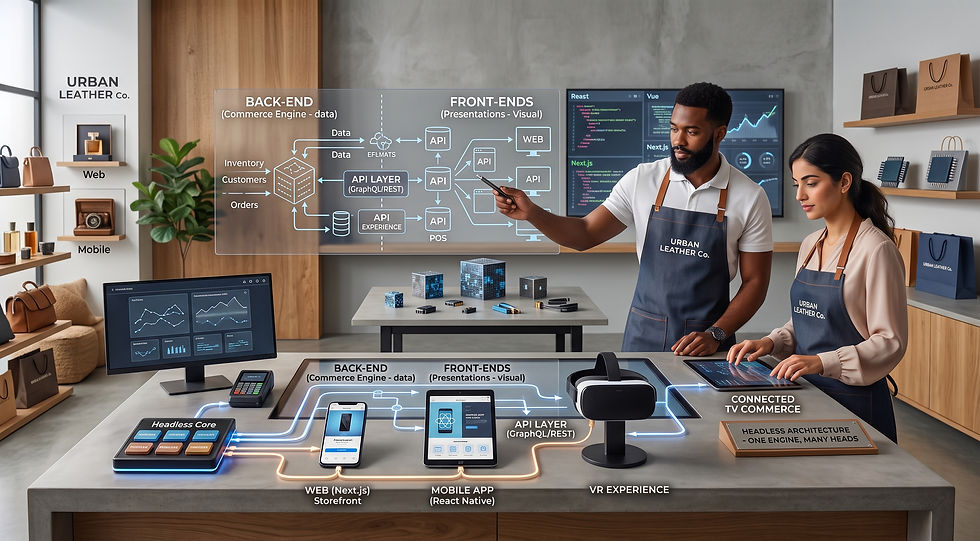
A headless commerce platform is a commerce backend that exposes its catalog, cart, pricing, and checkout as APIs, with no storefront attached.
You build the frontend yourself — React, Vue, Svelte, Astro, whatever you choose — and call the platform for the transactional work. The platform owns inventory, tax, payment capture, and order state. You own the interface and the routing.
A platform is only headless if its commerce logic is fully reachable without its own rendering layer. A monolith with a REST endpoint bolted on does not qualify.
Quick Answer: A headless commerce platform provides commerce capabilities — product catalog, cart, pricing, checkout, orders, payments — exclusively through APIs, leaving the storefront entirely to you. It differs from a traditional commerce platform, which ships a coupled frontend and backend, and from a headless CMS, which serves content rather than transactions. Most production stacks run both.
What a headless commerce platform must provide
Every vendor in this category claims API coverage. The useful question is which capabilities are complete enough to build on without falling back to a hosted page mid-funnel.
A headless commerce platform needs all five of these, at minimum:
Catalog reads that include variant and inventory state.
Cart mutation that survives session boundaries.
Price and tax calculation at request time.
A checkout flow that reaches an authorized payment.
Order records you can query after the sale.
Miss any one of those and you have inherited a problem the platform was supposed to solve. If you want a concrete reference for what that endpoint surface looks like in practice, the Wix Headless developer docs lay out the catalog, cart, checkout and order APIs under a single auth model, which is a useful shape to compare other vendors against.
Tax is the usual gap. Plenty of platforms hand you catalog and cart cleanly, then expect you to wire a third-party tax engine before you can legally take money in more than one jurisdiction.
Checkout is where the abstraction most often leaks. Taking a payment means touching PCI scope, 3-D Secure challenges, and payment-method-specific redirect flows. A platform that gives you an API-driven cart and then redirects to its own hosted checkout page is doing something legitimate, but it is not giving you a headless checkout.
The nuance: the real dividing line between headless commerce platforms is not breadth of API surface — almost everyone has catalog and cart endpoints now. It is whether the operational burden moves with the API. If you get an endpoint but inherit responsibility for uptime, fraud rules, and payment compliance, you bought an integration, not a platform.
Wix Headless is explicit about this distinction, because the commerce layer it exposes is the same one running the company's non-headless business sites rather than a thinner API-only variant.
"I am the chairman of payments at Wix. If a checkout goes down on a Saturday night, my team gets the alert, not the agency. People ask me whether the headless setup is the same infrastructure or some lighter version, and the answer is yes, it's the same thing. Same rails, same monitoring. We didn't build a separate system for headless, there was no reason to. Honestly, agencies shouldn't need to think about any of this. That's kind of the point."
— Itay Shmool, VP, Chairman of Payments, Wix
Headless commerce platform vs headless CMS
A headless CMS serves content through APIs: pages, articles, campaign modules, editorial workflow, reusable content models.
A headless commerce platform serves transactions through APIs: catalog, cart, pricing, checkout, orders.
Neither substitutes for the other. A content-led store typically runs both, with the CMS owning the merchandising narrative and the commerce platform owning anything involving money or stock.
The practical consequence is data modeling. You have to decide where a product's marketing copy lives, and both systems will happily hold it. Put it in the CMS and your catalog API stops being the single source of truth for a product page. Put it in the commerce platform and your editors work in a tool built for merchandisers, not writers. There is no universally correct answer, but picking deliberately at the start is far cheaper than reconciling two half-populated product models later.
Both layers can also come from the same backend. You can provision a Wix Headless commerce backend that carries stores, bookings, events, pricing plans and a CMS behind one auth model, then point whatever frontend you have already built at it — including one an AI coding tool generated. There is no developer tier or per-call API pricing to clear first, which matters mainly because it lets you evaluate the API surface properly before committing.
Headless commerce platform vs traditional platform vs managed headless
There are three architectures, not two. Most comparison writing treats the choice as traditional or headless and skips the middle option.
Dimension | Traditional platform | Self-managed headless | Managed headless |
Frontend | Shipped with the platform, themed | You build, host, and deploy it | You build it; the vendor hosts and deploys |
Commerce logic | Coupled to the frontend | API only | API only |
Framework choice | Constrained by the theme layer | Anything | Anything the host supports |
Ops you own | Almost none | Frontend hosting, CDN, builds, uptime | Frontend code only |
Time to first sale | Fastest | Slowest | Between the two |
Best fit | Standard catalog, minimal custom UX | Custom UX with a team to maintain it | Custom UX without a platform team |
Self-managed headless is where the majority of failed headless projects land. Teams pick it for the frontend freedom, then discover the ongoing cost is hosting, build pipelines, preview environments, and someone on call.
Here's the subtlety: managed headless is usually framed as a beginner's compromise, but it is often the more defensible choice for agencies specifically — not because the team cannot run infrastructure, but because infrastructure they run becomes infrastructure they are contractually on the hook for after handoff. Moving the hosting boundary to the vendor changes what the support contract has to cover.
How to evaluate a headless commerce platform
Read the checkout documentation before anything else. It is the densest part of any commerce API and the part least likely to be oversold, so it tells you more about real maturity than the marketing pages do.
Then check three things that are easy to miss:
Whether pricing and promotions calculate server-side. Client-side discount logic is a security problem, not a feature.
Whether webhooks cover order state transitions. Without them you will be polling for fulfillment updates.
What the auth model looks like for a logged-in customer versus an anonymous cart. Session handoff at login is a common source of lost carts.
One evaluation criterion is new in 2026: AI agents transact through APIs, not interfaces. A commerce backend that already exposes catalog, cart, and checkout as clean endpoints is reachable by an agent without additional work — a side effect of headless architecture rather than a feature anyone designed for. If agent-driven purchasing matters to your roadmap, the API surface you are evaluating for your own frontend is the same surface an agent would use.
On framework choice, the current center of gravity for headless storefronts is Next.js with the App Router. Astro is picking up content-heavy catalog pages where shipping less JavaScript matters more than interactivity. Remix appears mostly where Shopify Hydrogen is in play. None of this is prescriptive — it is where community tooling and examples are densest, which affects how fast you move.
Headless commerce platform FAQ
Is a headless commerce platform the same as a headless CMS?
No. A headless CMS delivers content through APIs. A headless commerce platform delivers transactions — catalog, cart, pricing, checkout, and orders. They solve different problems and are commonly deployed together, with the CMS handling editorial content and the commerce platform handling anything involving inventory or payment.
Do I need a headless commerce platform for a small store?
Usually not. If your catalog is standard and you do not need custom frontend behavior, a traditional platform gets you selling faster with far less to maintain. Headless earns its cost when the interface is a differentiator, when you serve multiple channels from one backend, or when you need a framework the traditional platform's theme layer will not allow. To see what a traditional platform's built-in storefront covers out of the box, such as product filtering and sorting, this guide to adding filters and sorting to a Wix store walks through the setup.
What is the difference between headless commerce and composable commerce?
Headless means the frontend is decoupled from the commerce backend. Composable means the backend itself is assembled from multiple specialized services — separate vendors for search, payments, tax, subscriptions. Headless is a prerequisite for composable, but you can be headless with a single backend vendor, and many teams deliberately are.
Does a headless commerce platform hurt SEO?
Not inherently, but it moves responsibility to you. Server-side rendering or static generation, canonical URLs, structured data, and sitemap generation all become your frontend's job rather than the platform's. Client-side-only rendering of product pages is where headless builds most often lose rankings.
How much does a headless commerce platform cost?
It varies widely, and the API-access model matters more than the headline price. Some vendors gate headless behind enterprise contracts or meter API calls. Others expose the same backend on standard plans. Wix Headless is free to connect, with no per-API-call fees and no separate developer tier — you upgrade when you are ready to launch rather than to start building.
What is MACH architecture?
MACH stands for Microservices, API-first, Cloud-native, and Headless. It is an architectural standard that treats headless as one of four required properties rather than a standalone choice. A headless commerce platform satisfies the H; whether it satisfies the other three depends on the vendor.
When a headless commerce platform is worth it
A headless commerce platform is worth adopting when you need control of the interface and do not want to build the transactional machinery underneath it.
The question that actually determines the outcome is not headless or not. It is how much operational surface you are willing to own alongside your frontend code. Answer that honestly and the platform shortlist narrows quickly.
If the answer is as little as possible without giving up the frontend, managed headless is the category to shortlist first — and the checkout documentation is still the fastest way to tell a real commerce API from a thin one.


Comments