Headless Ecommerce Framework: How to Choose the Right One
Updated: 2 days ago

A headless ecommerce framework is the combination of a commerce backend and a frontend technology that, together, let a store's design and its data run as two separate, independently replaceable pieces connected by an API.
Choosing one isn't really a single decision. It's several smaller ones stacked together: which engine holds your product data, which framework renders your storefront, and whether you host and run that infrastructure yourself or let someone else do it.
Most of the advice online treats this as a single platform pick. It's more useful to treat it as those three decisions made in order, because getting the order wrong is what makes a headless project take twice as long as it should.
Quick Answer: A headless ecommerce framework pairs a commerce backend (the engine that stores products, orders and inventory) with a frontend framework (React, Vue, Next.js) connected through an API. The choice comes down to three decisions: your backend engine, your frontend framework, and whether you self-host or use a managed service. Start with how much engineering support you actually have, since that narrows the field faster than any feature comparison.
What a Headless Ecommerce Framework Actually Decides
The term gets used as if it names one product, but it's really naming a stack of choices. Get the backend wrong and your frontend team inherits an API that can't do what the design needs. Get the frontend wrong and a perfectly good backend ships a slow, hard-to-maintain storefront.
Wix Headless developer docs lay out one version of this stack explicitly: a commerce backend with products, checkout and order management already built, paired with whichever frontend framework a team already uses, so the backend decision and the frontend decision don't have to be solved at the same time.
The backend engine — where product data, orders and inventory actually live, and what the API looks like for everything your storefront will need.
The frontend framework — React, Vue, Next.js or another option, chosen independently of the backend since the API doesn't care which one calls it.
The hosting model — self-hosted and fully owned, or a managed service that runs the infrastructure so your team doesn't have to.
The question we kept hearing from AI builders was: 'I've built something great, now how do I accept payments?' Wix Headless is the answer to that question. Payments, secure checkout, order management, it's already built and battle-tested. You just connect.
Attribution: Guy Ofeck, API Infrastructure, Wix
The nuance: A framework comparison chart makes this look like picking the fastest car. In practice, the deciding factor is almost always team capacity, not feature count. A small team with no backend engineers will do better with less flexibility and more done for them than with the most composable stack on the list.
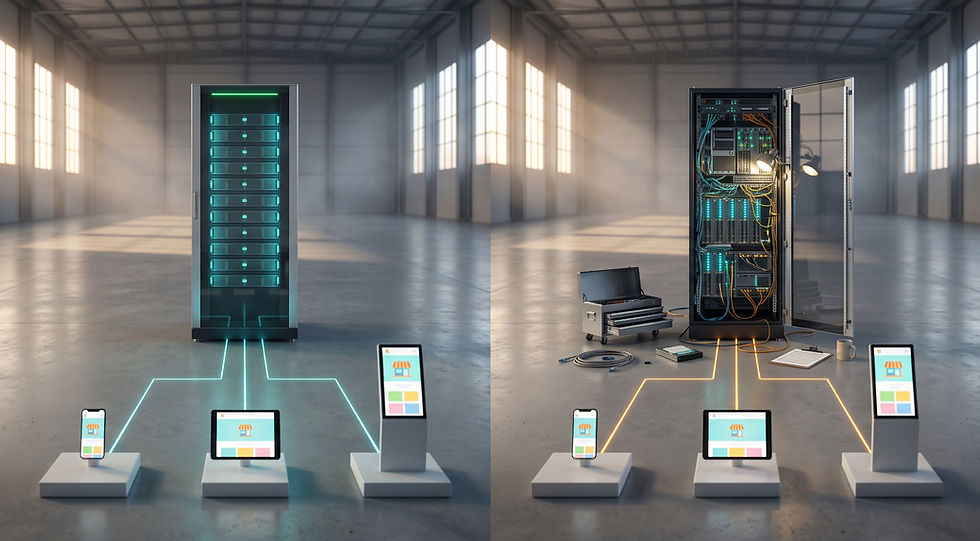
Open-Source vs Managed: The Real Fork in the Road
Before comparing specific platforms, there's a bigger decision underneath all of them: do you own and run the backend code yourself, or does a vendor run it for you?
Open-source engines like Medusa, Saleor or Vendure give you code-level control, which matters if your business model is unusual, regulated, or has data residency requirements a typical SaaS can't meet. That control comes with a standing cost: someone on your team owns uptime, security patches and scaling.
Managed platforms trade some of that control for a team that already runs the infrastructure. For a project that wants a headless commerce backend already built and running, that trade is usually the right one, since payments, checkout and order management arrive working rather than as a build item on the roadmap.
Here's the subtlety: Open-source doesn't mean free, and managed doesn't mean inflexible. A self-hosted engine still costs engineering time to run, often more than a subscription would. And a managed backend with a real API gives a frontend team just as much creative freedom as a self-hosted one, since the frontend was never the constrained part.
Headless Framework Models Compared
Model | Examples | Who owns infrastructure | Best fit |
Open-source, self-hosted | Medusa, Saleor, Vendure | Your team | Unusual business models, data residency needs, teams with backend engineers |
Managed SaaS backend | Wix Headless, BigCommerce, Shopify Hydrogen | The vendor | Teams that want commerce infrastructure already built and running |
Enterprise composable | commercetools, Adobe Commerce | A platform team, usually with implementation partners | Large organizations with the engineering org to assemble and maintain it |
How to Choose a Headless Ecommerce Framework
A practical way through the decision, in the order it actually needs to happen:
Count your actual engineering capacity before comparing feature lists — this narrows the field faster than any comparison chart.
Decide open-source versus managed first, since it changes which platforms are even worth evaluating.
Pick the frontend framework your team already knows, rather than the one a case study used, since familiarity beats novelty for shipping speed.
Check the API's coverage for the specific things your store needs — subscriptions, multi-currency, B2B pricing — before assuming a general-purpose API covers it.
Confirm payments and checkout are included or well-integrated, since this is consistently the part that takes longest to build from scratch.
Frequently Asked Questions About Headless Ecommerce Frameworks
Is a headless ecommerce framework more expensive than a traditional platform?
Not necessarily. A managed headless backend like Wix Headless runs as a subscription similar to a traditional platform. The expensive path is self-hosting an open-source engine without the team to maintain it, since that cost shows up as engineering time instead of a line item.
Do I need a separate CMS for a headless ecommerce framework?
Only if your backend doesn't include one. Some headless commerce backends bundle content management with product and order data; others expect you to pair a separate headless CMS alongside the commerce engine.
Can I switch frontend frameworks later without changing my backend?
Yes, that's the main advantage of the headless split. Since the frontend talks to the backend only through its API, swapping React for Vue, or adding a second frontend entirely, doesn't require touching the commerce engine underneath.
What's the difference between headless commerce and composable commerce?
Headless describes separating frontend from backend. Composable goes further, breaking the backend itself into separate best-of-breed services for search, pricing, inventory and more, each integrated individually rather than bundled into one engine.
Is Wix Headless a good fit for a small ecommerce team?
Yes, particularly for a team that wants commerce infrastructure, payments and checkout already built rather than assembled from separate services, since it removes the backend engineering work without limiting frontend framework choice.
Pick the Fork in the Road Before the Platform
The platform comparisons matter less than they look like they do. The decision that actually determines how the project goes is open-source versus managed, made honestly against the engineering capacity you actually have, not the one you wish you had.
Build on Wix Headless when the goal is a commerce backend that's already running, so your team's time goes into the frontend instead of standing up infrastructure first.


Comments