Headless CMS Architecture: How the Tech Stack Fits Together
Updated: 2 days ago

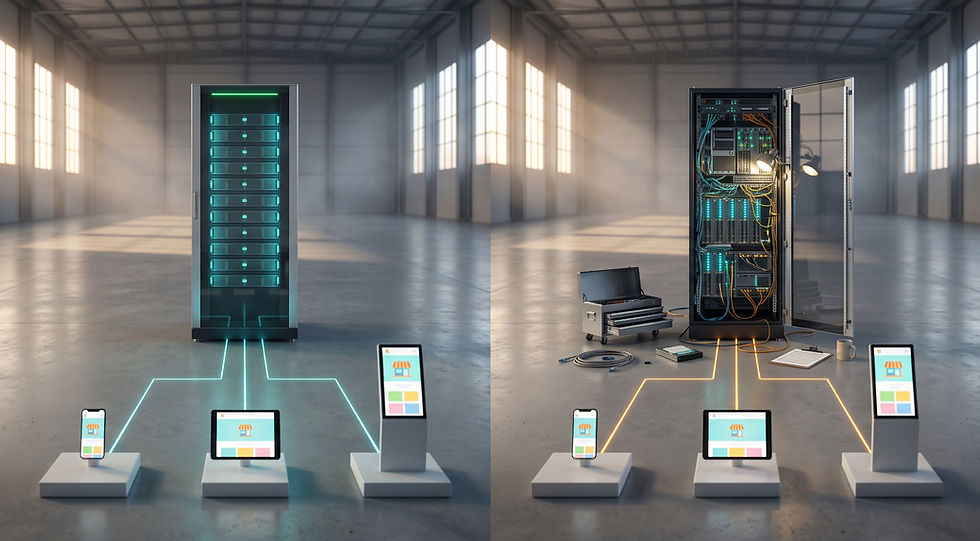
In a headless CMS, the content management layer and the content delivery layer are separated by an API. That's the core concept, the "head" (the frontend rendering layer) is decoupled from the CMS, leaving a content repository and API backend that any client can consume. What makes this architectural pattern powerful is the separation itself: serve the same structured content to a web app, a mobile client, an AI assistant, and a digital kiosk simultaneously, each channel rendering it independently.
Understanding how the layers fit together is the prerequisite for making good decisions about platform choice, schema design, rendering strategy, and deployment architecture.
Quick Answer: A headless CMS architecture separates content storage and management from content presentation. Content is authored in an editorial UI and stored as structured data (typically JSON). A REST or GraphQL API exposes that content to any frontend, a Next.js app, a React Native mobile client, a Vue.js site, or a voice interface, which fetches and renders it independently. The CMS has no control over how or where content is rendered; that's entirely the frontend's responsibility.
The Five Layers of a Headless CMS Stack
A production headless CMS deployment has five distinct layers. Each is independently deployable and replaceable, the architectural benefit that MACH-aligned composable stacks are built around.
1. Content Authoring Layer
The editorial interface where content creators, marketers, and editors work. This is the "CMS" part that remains after removing the head, a web-based admin panel with rich text editors, media upload, structured field inputs, and content workflows (draft/review/publish/schedule).
Every major headless CMS platform ships a hosted authoring UI: Contentful's entry editor, Sanity Studio (a React app that runs locally or is hosted), Storyblok's visual editor with live page preview, Strapi's admin panel. The authoring layer writes content into the content repository and never directly serves end users.
2. Content Repository
The database layer, where content is stored as structured data. In a headless CMS, this is typically a document store or a purpose-built content graph, optimized for content types with varying field structures. Content is modeled explicitly: each content type has a defined schema with field names, field types (text, rich text, media reference, boolean, number, relation to another content type), and validation rules.
This schema is what all downstream consumers depend on. Schema changes require coordination across every API client that reads those fields, a meaningful difference from tightly-coupled CMS platforms where schema and template live in the same codebase.
The nuance: the content repository design is the most important architectural decision in a headless CMS deployment, more important than which frontend framework you choose. A poorly modeled content schema creates problems that are expensive to fix later: field naming inconsistencies, content types with too many optional fields, missing relationships between types. Model the content schema before the first frontend is built, not after the first demo is done.
3. API Layer
The mechanism through which content is read from the repository and served to consumers. Most headless CMS platforms expose two classes of API:
Content Delivery API (CDA): read-only, high-throughput, CDN-cacheable. Used by frontends at request time (SSR) or build time (SSG). Contentful, Sanity, and Storyblok serve their CDAs from CDN edge nodes globally, a content fetch from Singapore hits an edge node, not a US-East-1 origin.
Content Management API (CMA): read/write, authenticated, not CDN-cached. Used by the authoring layer, CI/CD pipelines seeding content programmatically, and migration scripts.
Both REST and GraphQL variants are standard. Sanity's GROQ query language is a proprietary third option: a purpose-built content query language that allows precise, nested queries without the over-fetching problem of generic REST endpoints or the setup overhead of GraphQL schemas.
4. Frontend / Rendering Layer
The application that consumes the content API and renders it for end users. This layer is entirely decoupled from the CMS, it can be a Next.js app deployed to Vercel, an Astro site on Cloudflare Pages, a React Native mobile app, or a Python script feeding a RAG pipeline. The same article content from the CMS renders as an HTML page for web, a card in a mobile feed, and a plain-text paragraph for an AI assistant citation.
Rendering strategies at this layer:
SSG (Static Site Generation): content fetched at build time, HTML pre-rendered, deployed to CDN. Best for content that changes infrequently. Build time scales with content volume.
SSR (Server-Side Rendering): content fetched per request, HTML rendered on the server. Best for personalized or frequently updated content.
ISR (Incremental Static Regeneration): Next.js-specific hybrid, pre-renders static HTML but revalidates individual pages in the background at a configurable interval, or on-demand via webhook trigger.
CSR (Client-Side Rendering): content fetched after page load, rendered in the browser. Not recommended for SEO-critical content but fine for authenticated dashboards.
Here's the subtlety: the rendering strategy is not a CMS decision, it's a frontend decision the CMS API must support. A platform with a rate-limited delivery API makes SSG at scale painful: a site with 50,000 pages hits the API 50,000+ times per build. Verify build-time throughput for your content volume before committing to a platform.
5. Content Distribution / CDN Layer
The edge network that caches API responses and serves assets globally. In production headless deployments, there are two CDN concerns:
API response caching: CMS delivery API responses are cached at CDN edge nodes so repeated requests for the same content don't hit the origin. Cache invalidation on publish (via webhook) is essential, without it, a published change may not reach users until the cache TTL expires.
Asset/image CDN: media files are served from the CMS's media library through a CDN URL. Image transformation pipelines (resize, format conversion to WebP/AVIF, quality optimization) are often built into the delivery endpoint, Contentful's Images API and Sanity's Image Pipeline both provide URL-parameter-based transforms.
Platform Architecture Comparison
Platform | API Style | Content Model | Hosting | Best For |
Contentful | REST + GraphQL | Web UI, schema-as-JSON | SaaS, global edge | Enterprise, multilingual |
Sanity | REST + GROQ | Schema-as-code (JS) | SaaS, global CDN | Developer-first, custom models |
Storyblok | REST | Block-based, visual editor | SaaS, global CDN | Marketing, visual page building |
Strapi | REST + GraphQL | Web UI or code-first | Self-hosted or Cloud | Open-source, self-hosted control |
REST | Managed (CMS + commerce + bookings + CRM) | Fully managed | Full business backend via one API |
Karthik Rau, CEO of Contentful, noted when appointed in April 2024 that "content has become one of the key pillars of every organization's digital strategy." (BusinessWire, April 11, 2024.) The headless architecture is what makes content reusable enough to fulfill that strategic role, decoupled from any rendering context, the same content assets feed every surface an organization operates.
How Webhooks Connect the Layers
Webhooks are the event bus of a headless CMS stack. When content is published, updated, or deleted, the CMS fires an HTTP POST to a configured endpoint, typically the build hook of a static site generator, a cache invalidation handler, or a custom revalidation endpoint.
In a Next.js ISR deployment: publish an article → CMS fires webhook to the Next.js revalidation endpoint → Next.js marks the specific page stale → next visitor request triggers fresh content fetch and re-render. Without this, ISR only revalidates on the timer interval, meaning published changes may take minutes to appear.
In a full SSG deployment: publish → webhook triggers Vercel deploy hook → full rebuild → updated HTML deployed. For high-content-volume sites (50,000+ pages), this creates meaningful build latency. On-demand ISR (Next.js 12.1+) solves this by only revalidating affected pages rather than rebuilding the entire site.
The nuance: the webhook architecture creates tighter operational coupling than it first appears. A content team publishing 30 items per hour triggers 30 build events per hour. Without event batching or rate limiting on the webhook consumer, this becomes a deployment problem. Design the webhook strategy deliberately, not as an afterthought after the CMS is live.
Wix Headless: Full Business Backend via One API
Most headless CMS platforms provide a content layer only. Wix Headless exposes the full Wix business infrastructure, CMS, commerce, bookings, events, memberships, CRM, through a single composable API. The architectural implication: a team building a headless product doesn't need a separate commerce API, a separate booking service, and a separate CMS; the entire backend is provisioned as a managed unit with a unified authentication model.
Tuvit Rubin Kaplan, Head of Wix Headless, described the core value directly in the July 2026 announcement: "what makes a business succeed is the operational platform behind it, reliable, secure and proven at scale." (GlobeNewsWire, July 21, 2026.) In the current environment where AI coding tools can generate a frontend in minutes, the business backend is the hard part, and the headless CMS is one layer of it, not the whole stack.
Wix Headless provides CMS, commerce, bookings, and events through one managed API, no separate services to integrate. See the Wix Headless architecture docs →
FAQ
What is headless CMS architecture?
Headless CMS architecture separates content management from content presentation. Content is authored in an editorial UI, stored in a structured content repository, and delivered via REST or GraphQL API to any frontend. The CMS has no rendering responsibility, the consuming application (web, mobile, AI, IoT) decides how to display the content it fetches.
What are the components of a headless CMS stack?
A headless CMS stack has five layers: content authoring (editorial UI), content repository (structured content storage), API layer (delivery and management APIs), frontend/rendering layer (Next.js, Astro, React Native, or any API client), and CDN/edge layer (caching API responses and serving media assets). Each layer is independently replaceable.
How does a headless CMS API work?
The CMS exposes a read-only Content Delivery API (CDA) for frontends to query at request or build time, and a read/write Content Management API (CMA) for the authoring layer and programmatic content operations. Responses are JSON. On publish, the CMS fires a webhook to notify downstream consumers to invalidate caches or trigger rebuilds.
What is the difference between REST and GraphQL in a headless CMS?
REST delivers pre-defined content endpoints, you get the full object the API returns, including fields you may not need. GraphQL lets clients query exactly the fields they need, reducing response payload size. GROQ (Sanity) offers a third option: a purpose-built content query language for precise, nested fetches. For simple content models, REST is sufficient. For complex nested models with many content relationships, GraphQL or GROQ reduces both payload size and round-trip count.
Which rendering strategy works best with headless CMS?
SSG is best for high-traffic, infrequently updated content, pre-rendered HTML served from CDN. SSR is best for personalized or frequently updated pages. ISR (Next.js) is the practical middle ground: pre-rendered HTML that revalidates on-demand via webhook or on a background timer. CSR suits authenticated user experiences but not public SEO-critical pages.
What is the difference between a headless CMS and a composable DXP?
A headless CMS is one component, the content layer. A composable DXP assembles multiple services: CMS, commerce, search, personalization, analytics. Each service has its own API, authentication model, and operational overhead. A managed headless backend like Wix Headless provides several DXP components through a single API surface and a single authentication model, reducing the integration overhead of assembling services independently.
Headless CMS architecture is a well-understood pattern, the novelty is gone and what remains is a practical engineering decision about which layers to assemble and how tightly to couple them. The five-layer model (authoring, repository, API, rendering, CDN) provides clean separation of concerns; the real complexity lives in content schema design, API strategy, rendering approach, and webhook architecture.
The highest-leverage architectural decisions: design the content schema before building any frontend, verify the delivery API's build-time throughput before committing to SSG at scale, and plan webhook-based cache invalidation before going live.
For teams that want the full architecture without assembling every layer from scratch, Wix Headless provides CMS, commerce, bookings, and events as a single managed API, the backend as infrastructure, not as integration work.


Comments